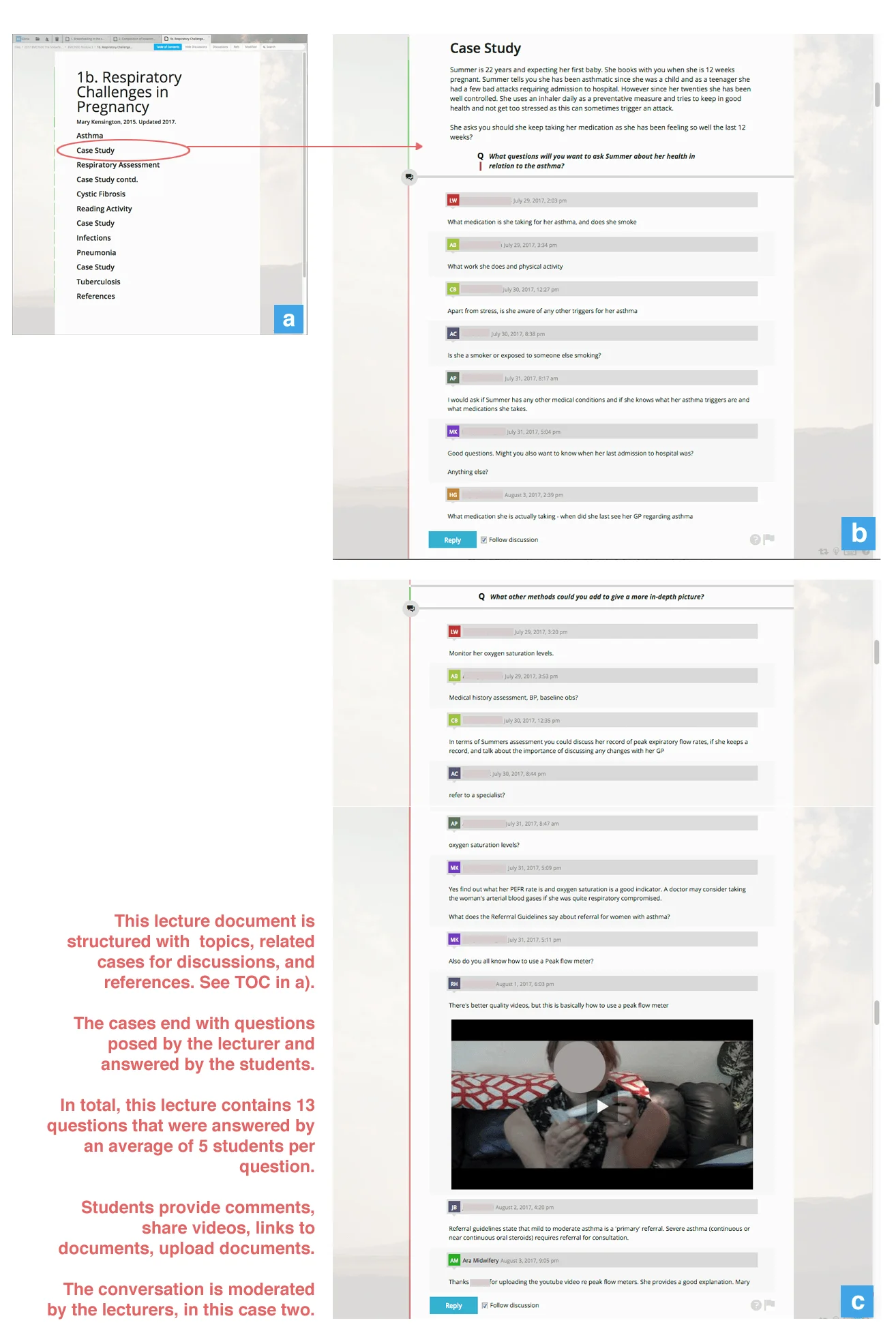
An OB3 curriculum content document with embedded Q&A. Lecturing staff author the document, then share it with students for asynchronous discussion. Figure sourced from ASCILITE 2017 Digital Poster (Gomez et al., 2017)
Curriculum Content with Q&A is one of OB3's core activity types. A lecturer authors a media-rich document — combining text, images, video, audio, and links — and embeds questions directly inside it, at the precise points where ideas appear. Students read and respond asynchronously, in discussions that live inside the content itself rather than in a separate forum.
The activity type addresses a structural problem that is well documented in distance and online education: when content delivery and discussion happen in different places, students feel isolated, unsure whether they are engaging correctly, and disconnected from their teacher and peers. Embedded Q&A is a design response to that disconnection.
In a conventional LMS, discussion forums sit in a separate module, structurally disconnected from the content. Students navigate away from what they are reading to post, then navigate back. The result, as one lecturer described it after moving to OB3, is that conversation and content were previously separate — finding OB3 "really inspiring" because discussion was now embedded within the content itself.
In OB3, discussion can start under any element in the document: a heading, a paragraph, a quote, an image, or an audio recording. Contributions can take the form of text, images, videos, or audio recordings. Every contribution is colour-coded and attributed to its author. No one can delete or tamper with another person's work, making the activity suitable for assessed and non-assessed use alike.
An OB3 curriculum content document with embedded Q&A. Lecturing staff author the document, then share it with students for asynchronous discussion. Figure sourced from ASCILITE 2017 Digital Poster (Gomez et al., 2017)
The differences described above are not merely technical. They reflect a deliberate pedagogical position. Dalziel and colleagues (2016, p. 2) put it plainly: learning design "looks inside the black box of pedagogy to understand what teachers and learners do together." When we choose a platform to teach in, we are choosing a learning design — often without realising it.
Most online platforms were not built for education from the ground up. Their affordances — what they make easy, what they make difficult, and what they make invisible — carry a learning design regardless of the teacher's intentions. A platform that separates content from discussion encodes a transmission model: the teacher deposits, the student retrieves. OB3 was designed to open that black box and make a different set of choices explicit: that discussion belongs inside the content, that teachers and students should work in the same space, and that every contribution should be visible, attributed, and protected.
Understanding why Curriculum Content with Q&A works as a learning design requires looking at what the platform makes possible — and what it makes unlikely. The concept of affordances helps here. Norman (2002) introduced affordances to describe the action possibilities a designed object makes available to its users. Conole and Dyke (2004, p. 113) applied this directly to educational technology, arguing that "a clear articulation of these affordances would enable us to understand how these technologies can be most effectively used to support learning and teaching." The following are the key affordances of OB3 for Curriculum Content with Q&A.
Contextual discussion. Questions and responses appear inside the document at the point where the idea occurs, not in a separate forum. Students engage with the content and the conversation simultaneously, which changes both the quality of responses and the experience of studying alone.
Familiar authoring. OB3 is built on the interactions people already know — copy and paste from Word, drag and drop from the desktop, embedding media from the web. A media-rich curriculum document with embedded Q&As can be built and shared in under an hour without specialist technical skills or educational design support.
Shared interface for teachers and students. Both groups author, share, and discuss in the same environment. This is unusual: most platforms separate the teacher's authoring tools from the student's reading and discussion space. In OB3, a lecturer and a student use identical interactions, which broadens participation and reduces training requirements for both.
Attributed and protected contributions. Every contribution is colour-coded by author and no one can delete or alter another person's work. This affords co-creation with integrity — every voice is visible, distinct, and persistent — making the activity suitable for assessed contributions as well as open discussion.
Configurable openness. Sharing permissions allow the teacher to set the level of visibility appropriate to the activity and the cohort: students may view and discuss, view and add, discuss with teachers only, or view their own content and add. This means the same activity type can serve introductory lecture content, peer discussion, and assessed collaborative work.
Media richness. Documents can embed video, audio, images, links, surveys, and Google Docs alongside text. Students can contribute to discussions in any of these forms. This affords multiple modes of engagement with complex content, particularly in technical or clinical disciplines where concepts are better explained through media than text alone.
These affordances are grounded in three educational concepts developed through OB3's design research. Study skills scaffolding (Bandura, 1986) reduces adoption barriers by building on familiar interactions. Networked learning (Goodyear et al., 2004) uses ICT to promote connections between learners and teachers and to create shareable representations of practice. Visual design and metacognition (Kirsh, 2005) uses visual cues in document templates to support cognition and orientation during online study.
In the same programme, the role of lecturers shifted from creators of passive content to creators of interactive content — embedding resources, questions, and activities in the context of the reading rather than in a separate forum, with students able to respond to each other's posts (Daellenbach et al., 2022).
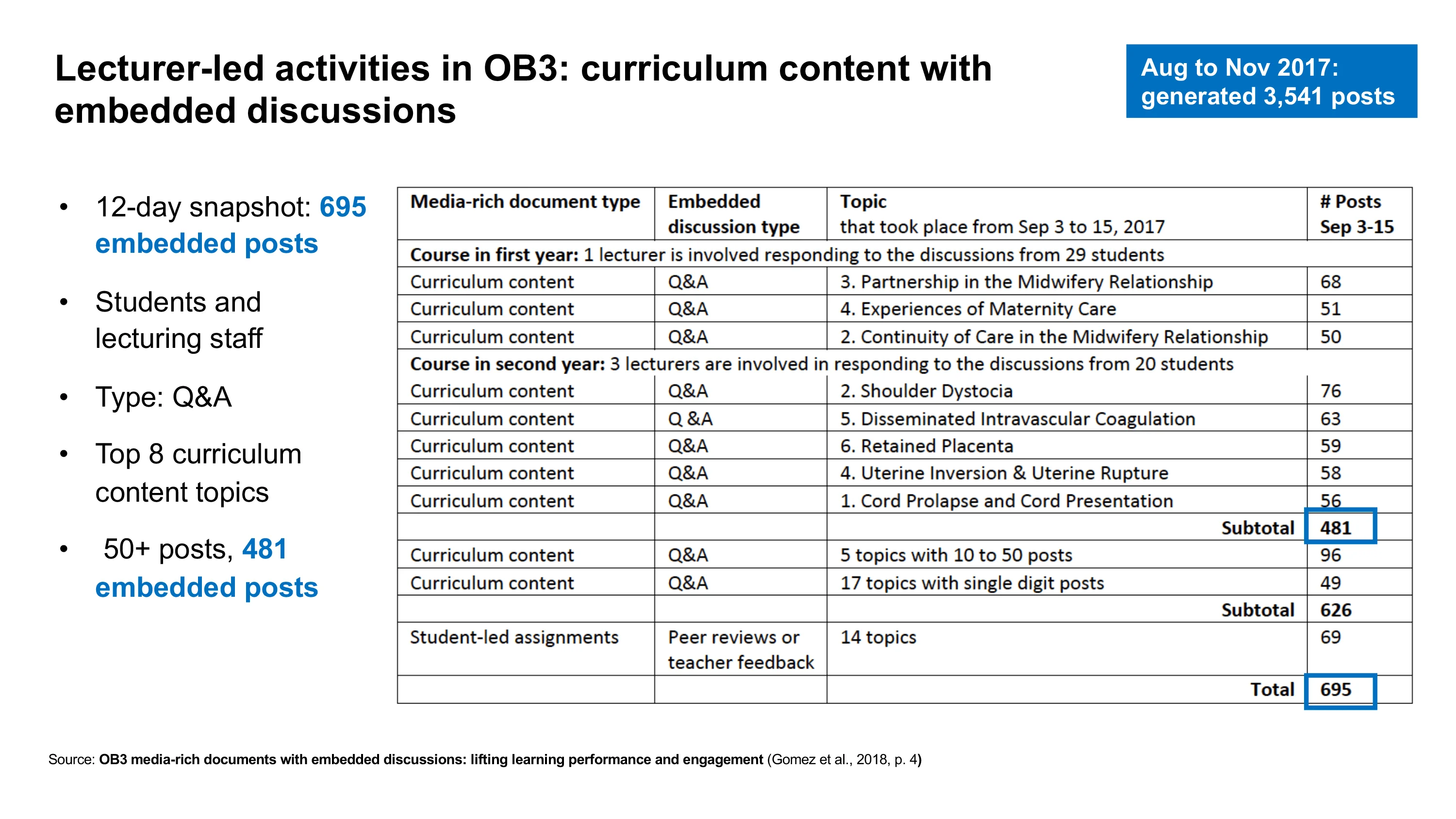
A 12-day snapshot of activity in OB3 curriculum content with Q&A. Table sourced from Gomez et al. (2018, p. 4) and also included in WILNZ 2023 presentation
The Bachelor of Midwifery at Ara Institute of Canterbury has used Curriculum Content with Q&A as the primary vehicle for delivering theoretical course content for 15 years. The joint Otago–Sydney Master of Medicine in Ophthalmic Basic Science uses OB3 documents to introduce students to technical information in anatomy, physiology, and optics, with embedded discussions and audio or video content used to deepen engagement with complex concepts (Gomez et al., 2017).
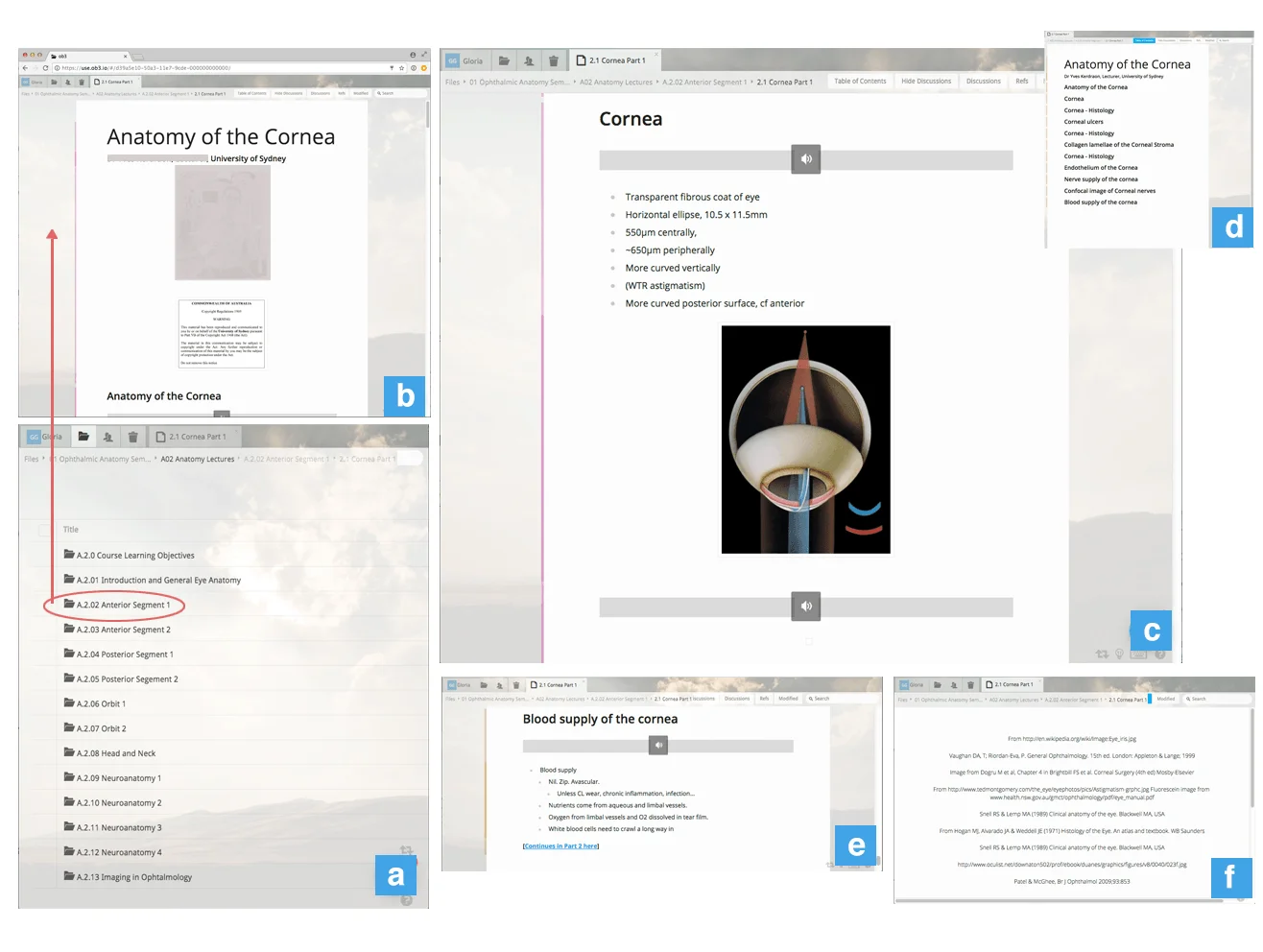
A media-rich OB3 lecture document used to introduce students to technical content in ophthalmology. Figure sourced from ASCILITE 2017 Digital Poster (Gomez et al., 2017)
See also the 2-minute video Authoring Content with Discussions, which shows how a Word document can be transformed into an OB3 document with embedded Q&A in minutes.